Additive manufacturing of porous polymer-derived ceramics with magnetic heating capability enabling an electrification of chemical processes
Additive manufacturing (AM) of ceramics enables the fabrication of optimized porous frameworks not only facilitating an efficient mass transfer of reactants and products essential in various energy- and environment-related applications, but – through the development and application of novel materials systems – also allowing for a targeted introduction of additional functionalities.
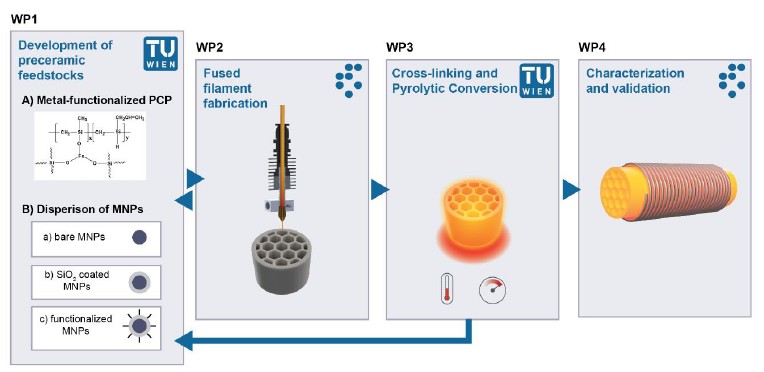
The main objective of this project is the development of groundbreaking new approaches towards the generation of complex-shaped ceramic components with tailored porosity and active magnetic heating functionality by combining filament-based AM with preceramic polymer technology and magnetic nanoparticles (MNPs) integration. Ultimately, we aim towards demonstrating the feasibility of our approach of developing novel functional porous materials in line with current efforts towards increased electrification of chemical processes.
In our three-pillar-based approach, we will (i) develop novel preceramic polymer systems suitable for the AM process of fused filament fabrication (FFF), (ii) incorporate MNPs into polymer-derived ceramics both by incorporation and in-situ generation, and (iii) combine these aspects to achieve magnetic heating functionality in FFF-shaped porous polymer-derived ceramics, identifying relevant process parameters and elucidating the underlying physico-chemical processes in all steps involved.
With the introduction or in-situ generation of MNPs into newly developed polymer-derived ceramics shapable by FFF, we propose a completely new approach towards facilitating AC-based heating of porous ceramic materials, significantly expanding the current state-of-the-art in the fields involved. Such active heating functionality will contribute towards stimulating the electrification of various processes, including active catalysis, enabling a readily switchable and dynamic operation, fast thermal cycles, and, generally, a more economical energy usage than conventional passive heating by fuel combustion.