Our research focuses on the development of wet-chemistry routes to multifunctional magnetic inorganic and hybrid nanomaterials. The fundamental building blocks are various types of nanoparticles that are physically or chemically coupled. Representative examples include magnetic catalysts as well as magneto-optic and magneto-electric nanocomposites.
Nanoparticles are integrated into bulk matrices through the careful design of their surface chemistry, enabling the fabrication of magneto-optic polymers and ferromagnetic liquid crystals. Complementary approaches include the synthesis of core–shell nanostructures, such as exchange-coupled bimagnetic nanoparticles, and the preparation of Janus nanoparticles.
Our activities are organized into four research groups: Hybrids and Liquid Ferroics; Magnetic Nanoparticles in Biomedicine; Magnetic Catalysis; and Nanostructural Characterization.
Magnetic catalysis:
Catalysts are involved in approximately 80% of the chemical transformations on which modern society relies. Efficient and stable catalysts are therefore essential for the sustainable production of chemicals and fuels. Among the strategies to achieve a green transition, the electrification of the chemical industry and energy production is a key approach, with electro(reduction) and electrolysis playing central roles. However, not all chemicals and fuels can be produced efficiently by purely electrochemical routes.
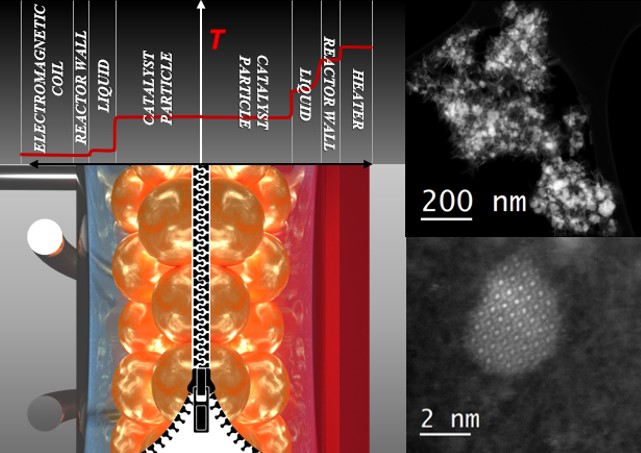
Our group develops catalysts that enable electrification through magnetic heating under an alternating magnetic field. This approach allows rapid and selective heating of the catalytic layer with precise temperature control. Such reactor concepts can also provide greater operational flexibility compared to conventional heating, which is particularly important for utilizing intermittent renewable electricity.
We design composite catalysts that combine magnetic and catalytic nanoparticles. Our work relies on advanced analytical techniques, including scanning transmission electron microscopy, microanalysis, spectroscopy, and magnetometry. In collaboration with catalysis specialists, we investigate how structural and surface properties influence catalytic activity, selectivity, and stability.
A key research direction is the study of how magnetic heating affects reaction kinetics, enabling innovative concepts for biomass conversion and for hydrogen storage and release from ammonia and liquid organic hydrogen carriers (LOHCs).
People

Gyergyek Sašo
Coordinator

Sedminek Anja
Resarcher

Raič Ivan
Resarcher

Makovec Darko
Resarcher

Anželak Bernarda
Resarcher

Križaj Kosi Nina
Resarcher